Showing posts with label NGS Magazine. Show all posts

05 October 2026

The October–December 2026 Issue of NGS Magazine is Now Online


The October–December 2026 issue of NGS Magazine, Volume 52, No. 4, is being printed and is now available digitally in the Members Only section of the website. This issue concludes the year-long theme of America250 by considering Next Steps. Note to longtime members and newer members who elected to purchase the print version of NGS Magazine: Delivery of print copies depends upon USPS schedules.


TABLE OF CONTENTS

Features

They’re Not “Dead Ends”: Documenting Relatives without Children

Loretta Evans, AG, AGL


From Family Archives to Community History: A Case Study in Stewardship

Trisha Mays-Cummings


Who’s the Brevard of “Brevard’s Chapel?” Finding and Saving Hidden History

André Kearns, MBA


Intergenerational Trauma in Family History: Objectivity, Standards, and Healing

Kate Townsend, CG


Million Mito and Mitotree

Roberta Estes, MS, MBA


Departments

PRESIDENT’S MESSAGE

David Rencher, AG, CG, FUGA, FIGRS, FNGS


EDITOR’S NOTE

Sunny Jane Morton


NGS NEWS

Family History Month

NGS 2028 Family History Conference: Winston-Salem

James Worris Moore Leadership Academy Beta Cohort

GRIP 2027

Awards Deadline

In Memoriam


REFERENCE DESK

How Historical Newspaper Access Keeps Improving

Kathy Petlewski, MA, MSLS


SOCIEY FORUM

Mentoring New Genealogists

Tamara Bell, MPA, SHRM-CP, CSM


GENTECH SOLUTIONS

David Rumsey Map Collection, Part II

Robert Raymond, MS


DNA DISCOVERY

Adoption and Unknown Parentage Searches: Tips for Success

Paul Woodbury, MEd, AG


NGS Magazine is published quarterly to update members of the National Genealogical Society on NGS activities and to provide genealogists with special information and guidance on conducting effective genealogical research. The magazine is sent to libraries by subscription. Online access to NGS Magazine is available as long as membership is active. An index to the titles and authors of articles in issues from 2005 to 2025 is available.

06 July 2026

Latest Issue of NGS Magazine Is Now Online


The July–September 2026 issue of NGS Magazine, Volume 52, No. 3, is being printed and is now available digitally in the Members Only section of the website. This issue continues the year-long theme of America250, with a spotlight on the 1900s.

Note to longtime members and newer members who elected to purchase the print version of NGS Magazine: Delivery of print copies depends upon USPS schedules.

TABLE OF CONTENTS


Features

1910 Census Entries: Fraud and Supplements

Michelle Chiachiere, CG


Finding Immigrants in US Records: A Layered Approach

Shayna Muckerheide, MLIS


When Relatives Disappeared: Mexican “Repatriation”

Colleen Robledo Greene, MLIS, FTxSGS


Researching the Ruthenians: Tracing Eastern Catholic and Orthodox Ancestors

Justin K. Houser


Presidential Censuses and Passenger Manifests, Part II

Stephen P. Morse, PhD


Departments

PRESIDENT’S MESSAGE

David Rencher, AG, CG, FUGA, FIGRS, FNGS


EDITOR’S NOTE

Sunny Jane Morton


NGS NEWS

NGS 2027 in Madison: Get Ready!

In Memoriam


NGS Awards and Competition Results Announced


REFERENCE DESK

The SS-5 Form: Its Origin and Genealogical Value

Kathy Petlewski, MSLS


SOCIEY FORUM

Redressing Redlining: Using Genealogy to Uplift Homeownership

Jennie Cole, MA, MLIS


GENTECH SOLUTIONS

David Rumsey Map Collection, Part I

Robert Raymond, MS


DNA DISCOVERY

Stronger Together: Correlating Multiple Forms of DNA Evidence

Paul Woodbury, MEd, AG


NGS Magazine is published quarterly to update members of the National Genealogical Society on NGS activities and to provide genealogists with special information and guidance on conducting effective genealogical research. The magazine is sent to libraries by subscription. Online access to NGS Magazine is available as long as membership is active. An index to the titles and authors of articles in issues from 2005 to 2025 is available.

03 April 2026

The April–June 2026 Issue of NGS Magazine is Now Online


The April–June 2026 issue of NGS Magazine, Volume 52, No. 2, is being printed and is now available digitally in the Members Only section of the website. This issue continues the year-long theme of America250, with an issue spotlight on the 1800s.

Note to longtime members and newer members who elected to purchase the print version of NGS Magazine: Delivery of print copies depends upon USPS schedules.


TABLE OF CONTENTS

Features

Diseases and Epidemics in the 1800s

Lori Lyn Price

Presidential Censuses and Passenger Manifests, Part I

Stephen P. Morse

Occupational Clues to an Immigrant’s Identity: A Case Study

Denise E. Cross, CG

Accessing US Synagogue Records for Jewish Family History Research

Ellen Shindelman Kowitt

A “Union Man” Dies as a Union Prisoner of War

William A. “Bill” Veselik


Departments

PRESIDENT’S MESSAGE

David Rencher, AG, CG, FUGA, FIGRS, FNGS

EDITOR’S NOTE

Sunny Jane Morton

TEN YEARS OF CONFERENCEKEEPER

2026 NGS EDUCATION SCHOLARSHIP RECIPIENTS

NGS NEWS

New Toolkit: For a More Welcoming, Inclusive Genealogy Community

Explore NGS’s New Online Member Community Space

In Memoriam

2025 NGS Donors and Volunteers


SOCIEY FORUM

Honoring Blue-Collar Ancestors: Inclusive Programming in Practice

Kate Townsend, CG


REFERENCE DESK

Emigrant Guides for Westward Travelers

Kathy Petlewski, MSLS


DNA DISCOVERY

Y-DNA and mtDNA for 1800s Research

Paul Woodbury, AG


GENTECH SOLUTIONS

Boo! Boolean Searching is NOT Scary

Robert Raymond


NGS Magazine is published quarterly to update members of the National Genealogical Society on NGS activities and to provide genealogists with special information and guidance on conducting effective genealogical research. The magazine is sent to libraries by subscription. Online access to NGS Magazine is available as long as membership is active. An index to the titles and authors of articles in issues from 2005 to 2024 is available for free.

28 April 2025

Sunny Jane Morton Named Editor of NGS Magazine


25 April 2025—The National Genealogical Society (NGS) is delighted to announce the appointment of genealogy educator, researcher, writer, and editor Sunny Jane Morton as the new editor of NGS Magazine. Her first issue will be the October-December 2025 issue. Morton takes over the reins from long-time editor Deb Cyprych, who is retiring after nine years of exceptional leadership.

Morton is currently the content director at Your DNA Guide and a contributing editor at Family Tree Magazine. She is a past editor of the Ohio Genealogy News, where she also succeeded Cyprych. With Harold Henderson, CG, she coauthored How to Find Your Family History in U.S. Church Records, which received a book award from NGS. Her book Story of My Life: A Workbook for Preserving Your Legacy is now in its second edition. Her forthcoming book, a guide for researching Catholic nuns and sisters in the United States, received research travel support from the Cushwa Center for the Study of American Catholicism at the University of Notre Dame. Her article "Delayed Birth Records in the United States" with Jeanette Sheliga appeared in NGS Magazine, Vol. 50, Number 1 (January-March 2024). She was also a contributor to the FamilySearch Blog from 2018-2023.

In addition to her extensive writing and editing, Morton is an instructor at NGS's GRIP Genealogy Institute 2025 (Practical Family History Writing) and the Salt Lake Institute of Genealogy Spring Virtual 2025 (Researching Women from 1850-1960).

Morton is a longstanding member of NGS and the Ohio Genealogical Society and an associate member of Archivists for Congregations of Women Religious. She has a double B.A. from Brigham Young University in History and Humanities. Morton is a frequent speaker and lecturer at national, state, regional, and local genealogy events.

Expressing her enthusiasm about her new position, Morton said, "My role is to reach out into the community and bring expert voices and unknown resources into reach for readers. I look forward to building on Deb Cyprych's legacy, supporting authors and finding exciting and timely topics for NGS Magazine, while contributing to the growth of our family history community."

Executive Director Matt Menashes, CAE, shared his excitement about Morton's appointment, stating, "We are so glad to have Sunny as the next editor of NGS Magazine. Her experience will serve readers well. Working with feature authors and regular columnists, Sunny will continue our tradition of exceptional writing on methodology, technology, DNA, reference resources, genealogical societies' needs, and more."

###

 Founded in 1903, the National Genealogical Society inspires, connects, and leads the family history community by fostering collaboration and best practices in advocacy, education, preservation, and research. We enable people, cultures, and organizations to discover the past and create a lasting legacy. The Virginia-based nonpro?t is the premier national society for everyone, from beginners to the most advanced family historians. NGS Magazine has a circulation of approximately 8,000 individuals and over 500 organizations, including libraries nationwide.


08 April 2025

The April–June 2025 Issue of NGS Magazine is Now Online


The April–June 2025 issue of NGS Magazine, Volume 51, No. 2, is being printed and is now available https://www.ngsgenealogy.org/magazine/ in the Members Only section of the website. 

Note to longtime members and newer members who elected to purchase the print version of NGS Magazine: Delivery of print copies depends upon USPS schedules.

This issue’s theme is the American Revolution.

In commemoration of the beginning of the American Revolutionary War in April 1775, this issue features records documenting the experiences of ordinary people involved in the cause for independence.

Lauren Gray and Elaine Heavey set the stage by discussing the pivotal events of 1775 that caused protests and boycotts to erupt into full-fledged war: Lexington, Concord, the British retreat, the Siege of Boston, Bunker Hill. The authors outline numerous sources for researching individual participants.

Throughout the war, and afterward, Americans appealed to the Continental and Confederation Congresses for a variety of reasons. John Deeben examines genealogical uses of Papers of the Continental Congress and describes methods for accessing them.

Sailors captured by the British were treated not as prisoners of war but as criminals participating in rebellion. Bryna O’Sullivan investigates the conditions and records of American seamen in prison ships in British-controlled ports and in English prisons.

Oaths of allegiance were required during the Revolution as a test of loyalty for public and military service and gradually expanded to most free men, with steep penalties for refusal. Reference Desk columnist Kathy Petlewski explores the history and availability of Revolutionary oaths of allegiance and lists of oath-takers.

The National Society of the Sons of the American Revolution (SAR), headquartered in Louisville, is the local host for the NGS Family History Conference in May. Walker Byer provides an overview of the SAR Genealogical Research Library’s onsite collections and online Patriot Research System.

Many other libraries with genealogical resources are located in Kentucky. Cheri Daniels highlights these repositories by region and summarizes Kentucky’s role in migration. Continuing a study of Ohio’s unusual land records, Liz Stratton concludes profiles of the state’s major subdivisions, lists available records, and presents a detailed research strategy.

The Society Forum columnist, Karen Molohon, reviews the NGS Delegate Council’s functions and achievements and shows how participating as an NGS organization member helps strengthen the genealogy community. In GenTech Solutions, Robert Raymond demonstrates step by step how to use Word software to accurately transcribe special aspects of manuscripts, such as archaic letters and abbreviation formats. For DNA Discovery, Paul Woodbury explains the benefits of considering amounts of DNA shared between genetic cousins of a tester and compares methods at four DNA testing companies.

TABLE OF CONTENTS


Features


Birth of the Revolution: Rediscovering the People and Events of 1775

Lauren Gray and Elaine Heavey


Using the Papers of the Continental Congress, 1774-1789, for Family Research

John Deeben


The Jersey and Old Mill: American Maritime Prisoners During the Revolution

Bryna O’Sullivan


Finding Patriots at the SAR Genealogical Research Library

Walker Byer


Ancestral Clues in Ohio’s Unique Land Records: Part 2

Liz Stratton


Departments


PRESIDENT’S MESSAGE

David Rencher, AG, CG, FUGA, FIGRS, FNGS


EDITOR’S NOTE

Deb Cyprych


NGS NEWS

Road Trip: Top Repositories for Kentucky Roots

Cheri Daniels


REFERENCE DESK

Friends or Enemies: Oaths of Allegiance During the American Revolution

Kathy Petlewski


DNA DISCOVERY

Shared DNA Between Shared Matches

Paul Woodbury, AG


SOCIETY FORUM

NGS and Organizational Members: Strengthening the Genealogy Community

Karen Molohon


GENTECH SOLUTIONS

The Power of Word: Special Characters

Robert Raymond


NGS Magazine is published quarterly to update members of the National Genealogical Society on NGS activities and to provide genealogists with special information and guidance on conducting effective genealogical research. The magazine is sent to libraries by subscription. Online access to NGS Magazine is available as long as membership is active. An index to the titles and authors of articles in issues from 2005 to 2024 is available https://www.ngsgenealogy.org/magazine/.

23 January 2025

Seeking the Next Editor of NGS Magazine


The National Genealogical Society (NGS) is seeking the next editor of NGS Magazine after the retirement of its long-time editor in mid-2025. The deadline to apply is 14 February 2025 at 5:00 p.m. (ET).

NGS Magazine is one of the Society’s premier benefits of individual/family membership. Each issue contains sixty-four pages of informative articles by experts in the field that provide researchers of all skill levels with specific guidance on conducting effective genealogical research. It also includes news and insights on items of importance to individual members and family history organizations. The editor is responsible for the content and production of four annual issues in January, April, July, and October. The editor manages the publication process from the initial concept to submitting the final layout to the printer.

The position reports to NGS’s executive director. The effective date for this position is 15 July 2025. The successful candidate will be responsible for producing the October-December 2025 issue.

To learn more about this position and qualifications, please see our website announcement.

23 October 2024

The October-December 2024 Issue of NGS Magazine is Now Online

The October-December 2024 issue of NGS Magazine, Volume 50, No. 4, is now available to members only on the website. This issue’s theme is Tax Records.


TABLE OF CONTENTS

Features

The Genealogical Value of Tax Records
Carol Cooke Darrow
 
Expanded Free Access to New Jersey Ratables
H. Husted, MLIS
 
Using Early Ohio Tax Records
Dana Ann Palmer, CG, CGL
 
Records of Tax Delinquency
J. Mark Lowe, FUGA
 
Taxation During the American Revolution
John D. Sinks, PhD
 
DAR and Revolutionary War Supply Taxes
Sara Louise Sukol
 
Irish Tax Records, Part 1: Tithe Applotment Books
Fiona Fitzsimons

Departments

PRESIDENT’S MESSAGE
David Rencher, AG, CG, FUGA, FIGRS, FNGS
 
EDITOR’S NOTE
Deb Cyprych
 
NGS NEWS
 
REFERENCE DESK
American Tax Revolts: Shays's Rebellion and the Whiskey Rebellion
Kathy Petlewski, MSLS
 
THE GENEALOGY TECHNOLOGIST
FamilySearch Full-Text Search: Part 2, Beyond the Basics
Robert Raymond
 
DNA DISCOVERY
DNA and Family Tree Tools
Paul Woodbury, MEd, AG
 
SOCIETY FORUM
History Helpers: Ten Volunteer Roles Every Genealogical Society Needs
Amy Lenertz, MLIS, MS, CFE
 
BOOK NOTICES


19 October 2023

The Fourth Quarter NGS Magazine is Now Online!


The October–December 2023 Issue of NGS Magazine is Now Online

The October–December 2023 issue of NGS Magazine, Volume 49, Number 4, is being printed and is now available online in the Members Only section of the website. Delivery of print copies depends upon USPS schedules. This issue’s theme is Sorting Out Identities.


EDITOR'S NOTE by Deb Cyprych


Names are crucial but unreliable markers of identity. When several people had similar names in one area, genealogists risk choosing the wrong person (and the wrong ancestors). Individuals whose names or other identifying characteristics changed can be missed in records, and the trail may seem cold for people with unknown surnames. Sorting out identities correctly is a constant challenge.

Other markers of identity, such as occupation and economic status, can differentiate people more precisely than names alone. Shannon Green discusses three techniques that can help researchers separate same-named people from each other and merge identities that appear to differ.

A case study with a surprising conclusion demonstrates the necessity of determining places and dates as identity characteristics. During a search for the parents of a man with minimal information, Julia Bagwell zeroed in on dates and places to separate him from others with the same name.

Every genealogist has an ancestress whose unknown maiden name blocks research of her birth family. Ann Lawthers describes a variety of records that may reveal a wife’s maiden name and recommends strategies specific to the search.

Sorting out the identities of African Americans with unrecorded, changed, and differing names requires knowledge of other distinguishing characteristics, particularly their kin. Tony Burroughs explores the complex history of African American naming and the resources that may help with identifying enslaved and free ancestors.

Immigrants often changed their names after arrival. Roslyn Torella investigates the typical reasons for changing names, the ways in which many names were changed, and the tools and resources for discovering the original surnames of immigrants.

Wrapping up the topic of sorting out identities, columnist Kathy Petlewski presents two case studies. One shows how changes in the spelling of a surname over time affect research, and the second recounts the evolution of the given names of eight siblings, including two who changed their first names entirely.

In other articles and columns, Robert Raymond explains the powerful set of tools researchers can adapt to improve outcomes, for searching the seven billion indexed historical records on FamilySearch; Cara Jones covers the value of local historical societies in genealogical research; Paul Woodbury provides instructions for DNA analysis, annotations, and citations; and Carla Cegielski outlines word lists, keyboards, and apps that can assist with translating records.

TABLE OF CONTENTS

Features

  • People Are More Than Names: Techniques for Differentiating Identities by Shannon Green, CG 
  • Names, Dates, and Places: The Foundations of Genealogical Research by Julia M. Bagwell, CG
  • Finding the Elusive Maiden Name by Ann G. Lawthers, Sc.D 
  • The Challenges of Tracing African American Identities by Tony Burroughs, FUGA
  • Rediscovering an Immigrant’s Original Surname by Roslyn Torella
  • Search Tips and Tricks for FamilySearch by Robert Raymond

Departments

  • PRESIDENT'S MESSAGE by Kathryn M. Doyle
  • EDITOR'S NOTE by Deb Cyprych
  • NEWS
  • REFERENCE DESK
    • Making Sense of Name Inconsistencies by Kathy Petlewski, MSLS
  • SOCIETY FORUM
    • The Importance of Local Historical Societies in Genealogical Research by Cara Jones, CG
  • DNA DISCOVERY
    • DNA Analysis, Annotations, and Citations by Paul Woodbury
  • TECH TIPS
    • Translation Tools by Carla S. Cegielski

NGS Magazine is published quarterly to update members of the National Genealogical Society on NGS activities and to provide genealogists with special information and guidance on conducting effective genealogical research. The magazine is sent to libraries by subscription. Online access to NGS Magazine is available only as long as membership is active.


18 July 2023

The Third Quarter 2023 Issue of NGS Magazine is Now Online


The July–September 2023 Issue of NGS Magazine is Now Online

The July–September 2023 issue of NGS Magazine, Volume 49, Number 3, is being printed and is now available online in the Members Only section of the website. Delivery of print copies depends upon USPS schedules. This issue’s theme is Back to School.


EDITOR'S NOTE by Deb Cyprych

Since every family presents a unique research situation, genealogists are perpetual students. To identify ancestors correctly and place them appropriately in their historical setting, we need to learn about the techniques most likely to be effective and the nuances of the records, resources, and repositories for each ancestral locale and period.

Fortunately, educational opportunities for genealogists have increased dramatically due to virtual platforms. In the first article for this back-to-school issue, NGS Education Director Angela Packer McGhie surveys the changing landscape of education and its variety of options to suit individual needs—from self-study to formal courses—based on preferred learning style and other factors.

Genealogical societies can contribute to the education of members by offering special interest groups (SIGs) and small study groups as part of their programming. Cari Taplin discusses the operation of both types of groups and the tendency for member interaction to lead to more active participation in society projects.

Another way to go back to school is to visit university libraries, which can be intimidating to many genealogists. Tim Pinnick explains how to tap their wealth of resources for African American history and genealogy in databases, microfilm, government documents, journals, books, and theses and dissertations.

Resources produced by and for students can add depth and character to family histories. Gail Shaffer Blankenau demonstrates the targeted, well-researched information in dissertations and theses, which have become more available due to digitization and databases allowing public access. Thomas Stephen Neel examines the types of photos, community context, and glimpses of personality that appear in high school and college yearbooks.

In the final back-to-school article, Kathy Petlewski compares the evolution of educational systems in three colonies (Massachusetts, Pennsylvania, and Virginia) to explore the likely experiences of ancestors and the availability of some colonial school records.

NARA archivist Claire Kluskens describes the scope and uses of a significant source for veterans and their families: the set of original bounty land warrant application files at the National Archives. NGS and NARA recently announced a joint project to increase accessibility by indexing and digitizing the 360,000 files.

The issue wraps up with Carla Cegielski’s investigation of search engines for identifying and accessing genealogical content, including general and genealogy-specific search engines, and Paul Woodbury’s analysis of potential clues in the profiles of mystery DNA matches for determining their identities, building their family trees, and ultimately discovering how they are related.


TABLE OF CONTENTS

Features

  • Bounty Land Warrant Application Files by Claire Kluskens 
  • Genealogy Education: A Changing Landscape by Angela Packer McGhie, CG, FUGA
  • University Libraries and African American Research by Tim Pinnick 
  • Using Theses and Dissertations to Enhance Family History by Gail Shaffer Blankenau, MA
  • What Can Genealogists Learn from Yearbooks? by Thomas Stephen Neel, MLIS

Departments

  • PRESIDENT'S MESSAGE by Kathryn M. Doyle
  • EDITOR'S NOTE by Deb Cyprych
  • NEWS
  • 2023 NGS Awards and Competition Results Announced by Judy Nimer Muhn
  • SOCIETY FORUM
    • Form Strong Membership Bonds in SIGs and Study Groups by Cari Taplin, CG
  • REFERENCE DESK
    • Roots of Education in America: A Comparison of Colonial Experiences by Kathy Petlewski, MSLS
  • TECH TIPS
    • Search Engines for Genealogy by Carla S. Cegielski
  • DNA DISCOVERY
    • Considering Every Clue in the Identification of Mystery Matches by Paul Woodbury

NGS Magazine is published quarterly to update members of the National Genealogical Society on NGS activities and to provide genealogists with special information and guidance on conducting effective genealogical research. The magazine is sent to libraries by subscription. Online access to NGS Magazine is available only as long as membership is active.


10 April 2023

The Second Quarter 2023 Issue of NGS Magazine is Now Online


The April–June 2023 Issue  
of the NGS Magazine is Now Online

The April–June 2023 issue of NGS Magazine, Volume 49, Number 2, is being printed and is now available online in the Members Only section of the website. Delivery of print copies depends upon USPS schedules. This issue’s theme is Methodology.


EDITOR'S NOTE by Deb Cyprych

This issue explores methodology: the approaches, procedures, and strategies that are most successful in genealogy. Application of best practices in methodology can help family historians solve or at least chip away at problems typically called brick walls.

As tempting as it may be to jump online and start searching databases, the first steps in any research project should be problem analysis and planning. Diana Elder outlines the steps: defining an objective, analyzing starting-point information, studying the location, developing a hypothesis, and identifying and prioritizing sources. Her case study demonstrates the process and the results.

When a county’s records have been destroyed or lost, it may seem that the trail has ended for an ancestral search. However, as Kelvin Meyers notes, researchers can pursue other options to find information. He recommends verifying the extent of the record loss, tracking down all surviving county records, checking other jurisdictions, and seeking records outside courthouses.

Sometimes an ancestor’s path seems to reach a dead end, but expanding research to relatives and associates often locates additional documents for the person or provides indirect evidence. Julie Stoddard discusses cluster research, including how and when to use it, identifying the people in an ancestor's cluster, and organizing the findings.

Information about events in family history may be unexpected, incomplete, or misleading. Researchers want to know the whole story: Why did it happen? What was the context? Jennifer Zinck presents two case studies to show how some questions can be answered by considering relevant laws and customs, resolving conflicts, using date calculators, and avoiding invalid assumptions.

Many Americans know little about Puerto Rico, a territory of the United States since 1898 and the point of origin for the second largest US Hispanic population. Debbie Gurtler describes Puerto Rico’s unique history, major record types, naming practices, language aids, and genealogical resources.

In this issue’s columns, David Rencher offers thought-provoking strategies for the leadership of genealogical societies, in light of current innovation disruptions; Paul Woodbury provides practical tips for contacting and exchanging helpful information with genetic cousins; Carla Cegielski explains five methods for finding online sources of downloaded images of unknown origin; and Kathy Petlewski explores the use of JSTOR’s scholarly journal articles in research.

I’m pleased to announce the availability of the first index to the titles and authors of NGS Magazine articles, covering issues between 2005 and 2022. For more information, see page 6. I hope the index will be useful for finding articles about genealogical topics that may assist in research.


TABLE OF CONTENTS

Features

  • Research Planning for the Win: Next Steps for Breaking Down a Brick Wall by Diana Elder, AG
  • Overcoming Record Loss by Kelvin L. Meyers
  • Finding New Evidence: Strategies to Improve Cluster Research by Julie Stoddard, MSc, AG 
  • Hidden Stories: Exploring the Unexpected in Family History by Jennifer Zinck, CG
  • Research on the Island of Enchantment by Debbie Gurtler, AG

Departments

  • PRESIDENT'S MESSAGE by Kathryn M. Doyle
  • EDITOR'S NOTE by Deb Cyprych
  • NGS NEWS
  • SOCIETY FORUM
    • Relevant Society Leadership in the Twenty-first Century by David E. Rencher, AG, CG, FUGA, FIGRS
  • DNA DISCOVERY
    • Tips for Contacting Genetic Cousins by Paul Woodbury
  • TECH TIPS
    • Strategies for Finding the Origin of an Image File by Carla S. Cegielski
  • REFERENCE DESK
    • Using JSTOR in Genealogical Research by Kathy Petlewski, MSLS

NGS Magazine is published quarterly to update members of the National Genealogical Society on NGS activities and to provide genealogists with special information and guidance on conducting effective genealogical research. The magazine is sent to libraries by subscription. Online access to NGS Magazine is available only as long as membership is active.

05 January 2023

1Q 2023 NGS Magazine is now online!


The January–March 2023 Issue  
of the NGS Magazine is Now Online

The January–March 2023 issue of NGS Magazine, Volume 48, Number 4, is being printed and is now available online in the Members Only section of the website. Delivery of print copies depends upon USPS schedules. This issue’s theme is the Mid-Atlantic Region.


EDITOR'S NOTE by Deb Cyprych

In celebration of the National Genealogical Society 2023 Family History Conference in Richmond, Virginia, this issue features articles about unique genealogical aspects of the Mid-Atlantic region. The area includes Delaware, the District of Columbia, Maryland, New Jersey, New York, Pennsylvania, Virginia, and West Virginia.

Genealogists with ancestry in Virginia and nearby states can combine attending the conference, sightseeing, and research in one trip. Online preparation will maximize the effectiveness of in-person research time while visiting repositories. Roccie Hill provides information about using online catalogs, finding aids, guides, abstracts, and indexes to find the locations of offline documents in libraries, historical and genealogical societies, and courthouses in Virginia.

The Library of Congress in Washington, DC, is just one hundred miles from Richmond. Candice Buchanan and Karen Walfall present a researcher’s guide to the catalog and collections of the largest library in the world, highlighting the genealogical resources in the Local History and Genealogy Section, reading rooms dedicated to other subjects, digital collections, and assistance available from librarians.

All seven states in the Mid-Atlantic region use irregular metes and bounds boundary descriptions in land records. Drawing plats based on these descriptions can enhance genealogical research in a number of ways. Gerald Smith explains how surveyors measured metes and bounds descriptions, where existing plats may be recorded, and how researchers can create their own plats to solve genealogical problems, by hand or in software.

During Virginia’s long history of settlement, a variety of court systems has handled civil and criminal cases. Despite the loss of records for some courts, valuable genealogical information remains for many others. Kathy Petlewski offers a timeline of Virginia courts and suggestions for locating their records.

Local militia service may be the reason why men not known to have served in federal military units were known by military titles. William A. Veselik details a case study about a Virginia militiaman, discusses the history of militias in the United States, and summarizes the sources of militia records.

In other articles and columns, Claire Kluskens explores unusual federal records digitized by the National Archives; Paul Woodbury makes recommendations for analyzing shared matches in DNA research; Carla Cegielski demonstrates how software can make the process of transcription easier and more enjoyable; and Cheri Hudson Passey outlines the array of resources available to member organizations on the NGS website.

TABLE OF CONTENTS

Features

  • NGS 2023 Family History Conference: Virginia is for Family History Lovers by Mary O’Brien Vidlak, CG
  • Online Preparation for a Research Trip to Virginia by Roccie Hill, MA
  • Metes and Bounds Land Plats Can Solve Genealogical Problems by Gerald Smith, CG
  • Library of Congress: Marvelous Resources, Open to All by Candice Buchanan, CG, and Karen Walfall
  • Tracing Military Service in State Militia Records by William A. “Bill” Veselik
  • Unusual Federal Census Records by Claire Kluskens

Departments

  • PRESIDENT'S MESSAGE by Kathryn M. Doyle
  • EDITOR'S NOTE by Deb Cyprych
  • NGS NEWS
    • Earn a Certificate in NGS’s New Institute-Level Online Course: Advanced Skills in Genealogy by Terry Koch-Bostic
  • REFERENCE DESK
    • Researching Virginia’s Early Court Records by Kathy Petlewski, MSLS
  • SOCIETY FORUM
    • Using the NGS Society and Organization Resources Web Page by Cheri Hudson Passey
  • DNA DISCOVERY
    • Working with  Shared Matches by Paul Woodbury
  • TECH TIPS
    • Tools to Make Transcribing Easier by Carla S. Cegielski

NGS Magazine is published quarterly to update members of the National Genealogical Society on NGS activities and to provide genealogists with special information and guidance on conducting effective genealogical research. The magazine is sent to libraries by subscription. Online access to NGS Magazine is available only as long as membership is active.

10 October 2022

The Newest Issue of NGS Magazine is Now Online!


The October–December 2022 Issue  
of the NGS Magazine is Now Online

The October–December 2022 issue of NGS Magazine, Volume 48, Number 4, is being printed and is now available online in the Members Only section of the website. Delivery of print copies depends upon USPS schedules. This issue’s theme is Ancestral Places.


EDITOR'S NOTE by Deb Cyprych

Although genealogists can’t physically travel back to the past, often we can visit the places where ancestors lived, worked, and worshipped. Even if those places no longer exist, traces remain in their history and records. The process of locating, visualizing, and researching specific places improves genealogical outcomes and adds details to family histories.

When a place name is found in a record, it has to be read, interpreted, identified, and located. Pam Vestal demonstrates a variety of ways to overcome obstacles in a search for locations, including difficult handwriting, low-quality images, garbled spelling, repetition of names, variations of names, and other challenging issues.

Land records are among the most valuable records in genealogical research, and fortunately, many are being digitized. Jean Atkinson Andrews discusses the types of public land records commonly found online. Her case study for an early settler illustrates the use of these records to discover details about his experience.

Maps are essential for understanding a place’s geography and proximity to potential record sources. Google My Maps makes it possible to compile historical information on a modern map and access it from a mobile device. Melinda Kashuba explains how to create, edit, annotate, and share maps in Google My Maps for genealogical purposes.

Every house has a story that can open doors into research for the people who lived there. Betsy J. Green explores techniques for researching the history of current and ancestral homes. Aaron Goodwin shares an example of how records in the New York City Municipal Archives provide historical background for a house.

Federal agricultural census schedules between 1850 and 1880 contain details about farmers’ land, crops, production, livestock, and cash values—up to one hundred items of information for each farm. Kathy Petlewski covers the development of the schedules and their locations in digitized and microfilm format, with a case study for how they can be used to enhance research.

The Genealogy Center at the Allen County Public Library in Fort Wayne, Indiana, has the agricultural census schedules for twenty-four states, as part of the largest genealogy collection in an American public library. John D. Beatty highlights the scope of the Center’s books, periodicals, microtexts, digital collections and databases, expert assistance, and free virtual educational programs.

In this issue’s columns, Carla Cegielski describes the benefits and components of family websites; Rhonda Hoffman concludes her article about society surveys by discussing online survey platforms; and Paul Woodbury explains tools for estimating the probability of different relationship levels based on amounts of shared DNA.

TABLE OF CONTENTS

Features

  • Where Did They Come From and Where Did They Go? Overcoming Obstacles in a Search for Ancestral Locations by Pam Vestal
  • Public Land Records Research Online by Jean Atkinson Andrews, CG
  • Using Google My Maps for Research, Analysis, and Sharing Information by Melinda Kashuba, PhD
  • Discovering a Home’s History by Betsy J. Green
  • The Genealogy Center at the Allen County Public Library by John D. Beatty, CG

Departments

  • PRESIDENT'S MESSAGE by Kathryn M. Doyle
  • EDITOR'S NOTE by Deb Cyprych
  • NGS NEWS
  • REFERENCE DESK
    • Using Agricultural Census Schedules in Family History Research by Kathy Petlewski, MSLS
  • TECH TIPS
    • Creating a Family Website by Carla S. Cegielski
  • SOCIETY FORUM
    • Surveying Society Memberships: Part 2, Online Surveys by Rhonda Hoffman, MLS
  • DNA DISCOVERY
    • Surveying Society Membership: Part 2, Online Surveys by Paul Woodbury

NGS Magazine is published quarterly to update members of the National Genealogical Society on NGS activities and to provide genealogists with special information and guidance on conducting effective genealogical research. The magazine is sent to libraries by subscription. Online access to NGS Magazine is available only as long as membership is active.


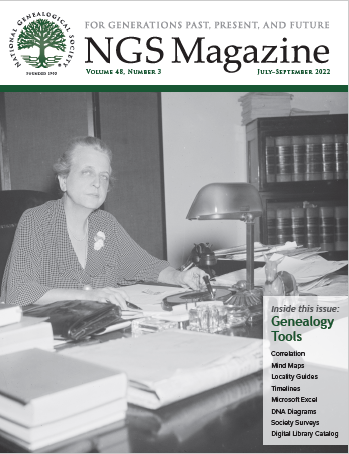
06 July 2022

The July–September 2022 Issue of the NGS Magazine is Now Online

The July–Sept 2022 Issue  
of the NGS Magazine is Now Online

The July–September 2022 issue of NGS Magazine, Volume 48, Number 3, is being printed and is now available online in the Members Only section of the website. Delivery of print copies depends upon USPS schedules. This issue’s theme is Genealogy Tools.

EDITOR'S NOTE by Deb Cyprych

Genealogical tools of various types can help researchers in charting a new course of discovery. The articles in this issue describe tools genealogists can develop for customized purposes.

Shannon Green explores the importance of correlation in the research process. Her examples illustrate the value of tables, maps, and timelines as tools of comparison and contrast that enable researchers to view data from a different angle, generate ideas for further study, test hypotheses, and assess and communicate the validity of conclusions.

Mind maps offer customized formats for following the trail of evidence. Amy Larner Giroux’s approach starts with a record rather than a central idea. She outlines four steps for using a hand-drawn or electronic mind map to plot the basic elements in the record, analyze information and develop questions, explore possible paths to find solutions, and create a research plan for the next steps.

Locality guides improve research effectiveness by increasing knowledge of a specific area and its resources. Jan Joyce discusses the advantages of creating succinct, individualized guides and presents a step-by-step process for their development and usage: targeting the geographic locality, conducting a literature review, writing the guide, using it, and refining its information.

Timelines are fundamental tools for gaining a new perspective in genealogical research. Cari Taplin describes the benefits, creation, and organization of timelines. Her examples display the use of timelines to notice gaps in research, suggest locations of records, distinguish the identities of people with similar names, and organize multiple items of information, among many other features.

Microsoft Excel’s power for analysis and manipulation of data is significant and can be tapped for many purposes. Jill Crandell provides instructions for calculations of ages and time intervals, sorting large volumes of data to solve research problems, and workarounds to handle Excel’s inability to format dates prior to 1900.

Columnists in this issue present information about genealogy tools as well. Paul Woodbury explains how the Leeds Method, SmartArt and Lucidchart, and What Are the Odds? can help with interpreting DNA evidence. Rhonda Hoffman discusses the development of questions for surveying society members. Kathy Petlewski describes her method of creating digital catalog cards to keep track of books and make them easily accessible.

On a different topic, Craig R. Scott uses a case study for an Illinois soldier to outline the sources available for researching US soldiers, sailors, volunteers, and militiamen in the Mexican War. More than one hundred thousand US servicemen participated in the 1846-1848 War with Mexico, which resulted in the United States obtaining a half million acres of territory in the West and Southwest.

TABLE OF CONTENTS

Features

  • NGS 2023 Family History Conference: Specialize Research Facilities in Virginia by Teresa Kelley
  • Correlation: A Powerful Research Tool by Shannon Green, CG
  • Enhancing Source Analysis with Mind Maps by Amy Larner Giroux, PhD, CG, CGL
  • Creating and Using Locality Guides as Genealogical Tools by Jan Joyce, DBA, CG, CGL, AG
  • Using Timelines to Gain Perspective on Research Problems by Cari A. Taplin, CG
  • Unlocking the Power of Microsoft Excel for Genealogical Research by Jill N. Crandell, MA, AG 
  • Researching US Servicemen in the Mexican war by Craig R. Scott, CG, FUGA

Departments

  • PRESIDENT'S MESSAGE by Kathryn M. Doyle
  • EDITOR'S NOTE by Deb Cyprych
  • NGS NEWS
    • Make Connections on FORUM by Kate Smith
    • 2022 NGS Awards and Competition Results Announced by Judy Nimer Muhn
  • DNA DISCOVERY
    • Charts and Diagrams for Genetic Genealogy: Organization, Analysis, and Reports by Paul Woodbury
  • SOCIETY FORUM
    • Surveying Society Memberships: Part 1, Questions by Rhonda Hoffman, MLS
  • REFERENCE DESK
    • Maintaining a Personal Genealogy Library Catalog in the Digital Age by Kathy Petlewski, MSLS

NGS Magazine is published quarterly to update members of the National Genealogical Society on NGS activities and to provide genealogists with special information and guidance on conducting effective genealogical research. The magazine is sent to libraries by subscription. Online access to NGS Magazine is available only as long as membership is active.