17 December 2020

Order NGS Holiday Special Gift Packages Now


Time Is Running Out to Order
Holiday Special Gift Packages from NGS

Time is running out to order holiday special packages from the National Genealogical Society for your family and friends. If you place your order before noon on 23 December, we will make sure that your gift recipient will be notified of your present before 24 December. 

All orders placed from noon on 23 December through 3 January will be processed on Monday, 4 January. Great savings on our holiday special gift packages end 5 January 2021.

These packages feature some of our most popular genealogy courses. They are ideal gifts for anyone on your holiday gift list who is interested in learning more about family history research because all of the courses are online using an e-learning system. Whether you purchase a package for a family member, a friend, or even for yourself, the recipients of your gifts can join from home or on-the-go and complete coursework at their own pace and on their own schedule.


Holiday Package #1: Save $30

Holiday Package #1 offers two online courses: Reading Old Handwriting and Transcribing, Extracting, and Abstracting Genealogical Documents.


Holiday Package #2: Save $25

Holiday Package #2 includes the War of 1812 Records course and Researching Your Revolutionary War Ancestors course.


Holiday Package #3: Save $25

Holiday Package #3 combines a DNA related online course and a video of a live-presentation lecture webinar. This package includes the course Understanding and Using DNA Test Results and the lecture, "Your Cousins Are Your Secret Weapon," by genetic genealogy expert Angie Bush, plus a four-page syllabus.

All online courses must be completed within six months of registration; however, an extension may be requested. To learn more, visit NGS. For more information about specific courses, see NGS Continuing Genealogical Studies.

07 December 2020

NGS Holiday Special Gift Packages


Holiday Special Gift Packages from NGS

The National Genealogical Society is offering holiday special packages for some of its most popular genealogy courses with great savings for our members. This holiday offer is time limited. The sale starts 7 December 2020 and ends 5 January 2021.

These packages are ideal gifts for anyone on your holiday gift list who is interested in learning more about family history research because all of the courses are online using an e-learning system. Whether you purchase a package for a family member, a friend, or even for yourself, the recipients of your gifts can join from home or on-the-go and complete coursework at their own pace and on their own schedule.


Holiday Package #1: Save $30

Holiday Package #1 offers two online courses: Reading Old Handwriting and Transcribing, Extracting, and Abstracting Genealogical Documents.


Holiday Package #2: Save $25

Holiday Package #2 includes the War of 1812 Records course and Researching Your Revolutionary War Ancestors course.


Holiday Package #3: Save $25

Holiday Package #3 combines a DNA related online course and a video of a live-presentation lecture webinar. This package includes the course Understanding and Using DNA Test Results and the lecture, "Your Cousins Are Your Secret Weapon," by genetic genealogy expert Angie Bush, plus a four-page syllabus.

All online courses must be completed within six months of registration; however, an extension may be requested. To learn more, visit NGS. For more information about specific courses, see NGS Continuing Genealogical Studies.

02 December 2020

Call for Proposals for NGS 2022 Family History Conference


NGS Announces Call for Proposals 

for 2022 Family History Conference


The National Genealogical Society will hold its 2022 Family History Conference, Our American Mosaic, in Sacramento, California, 25‒28 May 2022. We will open the call for proposals on 2 December 2020 and proposals will be accepted until 1 April 2021.

Across the dramatic landscape that became America, our diverse ancestors each contributed a precious piece to the colorful design of our American mosaic. In the West, Native American cultures have thrived for thousands of years. While eighteenth-century American colonists were fighting for independence from Great Britain in the East, the Spanish were establishing missions and military outposts in what is now California. The discovery of gold near Sacramento in 1848 sparked a frenzy of migration to California from Asia, Mexico, and the eastern states. The lure of western skies has continued to the present day, attracting ranchers, Dust Bowl refugees, the Great Migration of African Americans from the South, immigrants fleeing poverty or persecution, and technology entrepreneurs.

Our family histories make each of us unique, and our separate stories are a shared history within our American mosaic. Attendees at the 2022 NGS Family History Conference in Sacramento will benefit from lectures and workshops to help build skills in methodology and the use of records and resources to advance their genealogical research.

Conference tracks and topics under consideration include the following: African American research; Asian and Pacific Islander research; DNA; European and Middle Eastern research; Hispanic and Latin American ancestry; immigration and migration; methodology; Native American research; New England research; non-traditional families; records and repositories; reference services; society management; technology; the 1950s; western states; and writing.

Speakers who wish to submit lecture proposals may submit up to eight proposals electronically. The speaker compensation is described in detail on the website. Please visit the website for details about required speaker information and each submitted proposal.

NGS has a free webinar, Becoming a Better Conference Speaker: Proposals and Preparations, which can be found on the National Genealogical Society YouTube channel. Speakers are encouraged to view the webinar before beginning the proposal process.

NGS members will receive first consideration as speakers. Notifications for acceptance will be issued in the fall of 2021. Syllabus material, due 1 February 2022, is required for each lecture or workshop presentation and will be included in the syllabus distributed to all conference registrants. Speakers are expected to use electronic presentation programs and provide their own digital projector, laptop or tablet, and connector to the projector cable. NGS will provide projector support, which consists of a VGA or HDMI cable, cart, and power strip. Internet connections will not be provided in lecture rooms.


25 November 2020

Happy Thanksgiving from NGS!


The National Genealogical Society wishes you and your family a wonderful Thanksgiving holiday.

In this very memorable year, we celebrate the strength of family connections. We are grateful to be connected to you.

Thank you for your continued support throughout the year. And an extra dose of gratitude to the many volunteers who make our success possible.

Be safe and stay well,

The NGS Staff and Board of Directors

Please Note: The NGS office will close for Thanksgiving at 3:00 p.m. Wednesday and will reopen Monday with normal business hours.


We thought you might enjoy Thanksgiving Goes Virtual: How to Carve Out New Traditions Amid the Ongoing Pandemic from the Washington Post. It includes suggestions from NGS on sharing family stories.


24 November 2020

New Books for Arizona and Nevada Research from NGS

 NGS Introduces Two New Research in the States Books: Arizona and Nevada


NGS is pleased to announce the publication of two new books as part of its Research in the States series, which now covers research in twenty-nine states. The newest volumes are Research in Arizona by David E. Rencher, AG, CG®, FUGA, FIGRS, and Research in Nevada, by Stefani Evans, CG. The books are available in the NGS store in both PDF and print versions.

Both guidebooks provide detailed information on a wealth of resources, including:
  • Archives, Libraries, and Societies
  • Atlas, Gazetteers, and Maps
  • Business, Cemetery, Ethnic, Institutional, Military, and Naturalization Records
  • Organizational Records, Directories, and Newspapers
  • Probate, School, State, Tax, and Vital Records
  • Railroads, Religious Records, Women, and more
The authors include the website address, physical address, and telephone number for each resource.

In Research in Arizona, Rencher also provides detailed information for those researching Native American ancestors, which include Apache, Hopi, Navaho, and Pueblo of Zuni tribes. The guidebook covers Arizona’s pre-territorial, territorial, federal, and Indian censuses. For those researching Spanish and Mexican ancestors, Research in Arizona offers helpful information on finding records from the state’s pre-territorial periods when it was ruled by Spain (1562–1821) and Mexico (1821–1853).

The author also includes out-of-state repositories for Arizona related records.

Rencher is the director of the Family History Library in Salt Lake City, Utah, and the chief genealogical officer for FamilySearch, and serves on the NGS board of directors as chair of the Development Committee. He is the Irish course coordinator and instructor for several prestigious genealogical institutes. He also is the past chair of the joint committee for Record Preservation and Access and a Fellow of Utah Genealogical Association.

Research in Nevada discusses Nevada’s land records and the Desert Land, Homestead, and Taylor Grazing Acts. Water and mining records are noted as are records from the Great Depression including the Civilian Conservation Corps (CCC) Enrollee Records and works created by the Works Projects Administration. Evans also includes records of brands as well as resources to aid genealogists interested in researching ancestors who worked on the construction of the Hoover (Boulder) Dam or lived in Boulder City during that time.

Evans has served as an NGS director, Board for Certification of Genealogists (BCG) trustee, BCG Education Fund trustee, and Nevada Delegate for the Southwest Oral History Association. She chaired the NGS 2013 Family History Conference in Las Vegas and has written for the NGS Quarterly, NGS Magazine, and the NYG&B Record.

Research in the States series is edited by Barbara Vines Little, CG®, FNGS, FVGS, a former NGS president and editor of the Magazine of Virginia Genealogy. Research in Arizona and Research in Nevada are available for purchase in the NGS online store in both PDF and print versions.


11 November 2020

NGS Introduces New Course: Reading Old Handwriting


NGS Introduces New Online Course: Reading Old Handwriting


The National Genealogical Society introduced today the newest course in its Continuing Genealogical Studies series, Reading Old Handwriting. This illustrated course is essential for everyone researching their family tree. It offers family historians tips to understand hard-to-read handwriting in documents such as wills and deeds. Its practice exercises teach how to read and interpret handwritten land records, probate files, and, of course, your ancestors’ personal letters.

NGS Education Director Angela McGhie states, “…the ability to read old handwriting is a foundational skill for understanding many of the documents family historians discover in their research. Being able to read old handwriting is the first step in interpreting genealogically relevant facts. Our new course Reading Old Handwriting complements NGS’s course, Transcribing, Extracting, and Abstracting Genealogical Documents, which was released in June 2020.”

The course guides genealogists through ten modules. Every module has multiple hands-on exercises to help family historians develop expertise in reading documents from a variety of locations and time periods. Course author Carla S. Cegielski is a freelance genealogical researcher and author of the Tech Tips column in the quarterly NGS Magazine.

For more information and to register, visit Reading Old Handwriting on NGS’s website.

07 October 2020

Nominations Open for NGS 2021 Awards and Competitions


Nominations Open for NGS 2021 Awards & Competitions


The National Genealogical Society (NGS) invites individuals, societies, and organizations to participate in its 2021 Awards and Competitions program. NGS annually recognizes excellence in the field of genealogy. This year we have expanded our program to reflect our merger with the Federation of Genealogical Societies. The deadline for submission of nominations is 15 December 2020.

The NGS Awards program recognizes scholarship, service, excellence, and achievement in the fields of genealogy, history, and biography by presenting awards to individuals, societies, and organizations. The Society’s competitions include

  • Family History Writing Contest
  • Award for Excellence: Genealogy or Family History Book
  • Award for Excellence: Genealogical Methods and Sources
  • Award for Excellence: NGSQ
  • The NGS Newsletter Competition
  • The Rubincam Youth Writing Competition

NGS also inducts one person each year into its National Genealogy Hall of Fame. See a full description of the awards and competitions and access nomination forms on the NGS website.

“We encourage family historians and genealogists to nominate an organization they know or an individual they work with, research with, or admire for an award or competition,” said Janet L. Bailey, chair of the award committee. “There are so many outstanding individuals, societies, and organizations that deserve national recognition. We hope their peers will consider nominating them before December 15."

06 October 2020

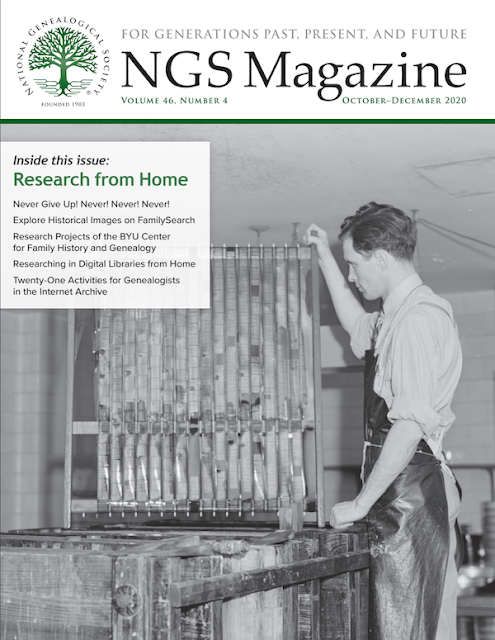
The October-December 2020 Issue of NGS Magazine is Now Online

NGS Magazine cover

The October–December 2020 issue of NGS Magazine, Volume 46, Number 4, has been mailed to members and is available online in the Members Only section of the website. This issue's theme is "Research from Home."


EDITOR'S NOTE by Deb Cyprych

Six months after the COVID-19 pandemic led to lockdowns around the world, many libraries and archives have limited access. The National Archives, the Library of Congress, and the Family History Library are still closed as this issue goes to press. Libraries and archives that have reopened will likely have restrictions for some time. In these circumstances, research from home has become a primary method for genealogists tapping into digitized books, scanned records, and databases online.

Claire Mire Bettag tells a story of persistence and amazing payoffs. After a twenty-year search for the origins of her ancestor, she found a tip referring to a digitized administrative report that eventually led her to information about three generations in notarial records. While serendipitous, her story is not unique. Genealogists who continue to search broadly may find such treasures online, too—perhaps even a virtual tour of an ancestor’s neighborhood, as Claire found.

FamilySearch continues to increase access to digitized records. Its new system, Explore Historical Images, publishes images faster than ever before, so quickly that many are not yet indexed by name or listed in the catalog. Robert Raymond explains how to locate and view them in Explore Historical Images by searching for place, date, and life event. He also discloses the next innovation for FamilySearch: Computer Assisted Indexing of historical records.

All researchers can view the results of research projects published by students at Brigham Young University’s Center for Family History and Genealogy. Jill Crandell describes the topics: European emigrant records, script tutorials for eight languages, pre-1841 British census records, Chester and Lancashire marriages, Discovering English Ancestors, Kinship and Poverty in Early Modern Britain, the Nauvoo Community Project, and Welsh Mormon History.

Kathy Petlewski uses two search terms to explore and compare four free digital libraries of interest to historians and genealogists: Google Books, HathiTrust, Digital Public Library of America, and FamilySearch Digital Library. Carla Cegielski discusses the scope of the Internet Archive, a digital library where reading is just one of the twenty-one useful and even entertaining activities for genealogists.

In this issue’s other articles, David Lambert provides an overview of the most recent scholarship for the Mayflower passengers’ descendants and the prime sources for researching Plymouth Colony families; Paul Woodbury demonstrates how to establish a strong foundation for future genetic genealogy research success by creating a detailed profile, preparing lists of ancestral surnames, and uploading a family tree; and Debbie Smyth shows how learning skills in transcribing, abstracting, and extracting can enable genealogists to overcome obstacles and achieve more accurate research and analysis results.


TABLE OF CONTENTS

Features

  • Developing Genealogical Skills in Transcribing, Extracting, and Abstracting by Debbie Wilson Smyth
  • Never Give Up! Never! Never! Never! by Claire Mire Bettag, CG, FUGA, FNGS
  • Explore Historical Images on FamilySearch by Robert Raymond
  • Research Projects of the BYU Center for Family History and Genealogy by Jill N. Crandell, MA, AG
  • Resources for Researching Mayflower Descendants by David Allen Lambert

Departments

  • PRESIDENT'S MESSAGE Welcome to the New NGS by Kathryn M. Doyle

  • NGS NEWS
    • Call for Proposals for NGS 2022 Family History Conference

    • NGS 2021 Family History Conference: Welcome to Virginia! by Robin Dwyer-Maurice and Teresa Kelley


  • REFERENCE DESK
    • Researching in Digital Libraries from Home by Kathy Petlewski, MSLS
  • TECH TIPS
    • Twenty-One Activities for Genealogists in the Internet Archive by Carla S. Cegielski
  • DNA DISCOVERY
    • Foundations for Genetic Genealogy Success: Profiles and Family Trees by Paul Woodbury

NGS Magazine is published quarterly to update members of the National Genealogical Society on NGS activities and to provide genealogists with special information and guidance on conducting effective genealogical research. The magazine is sent to libraries by subscription. Online access to NGS Magazine is available only as long as membership is active.